
- Details
- Sports News
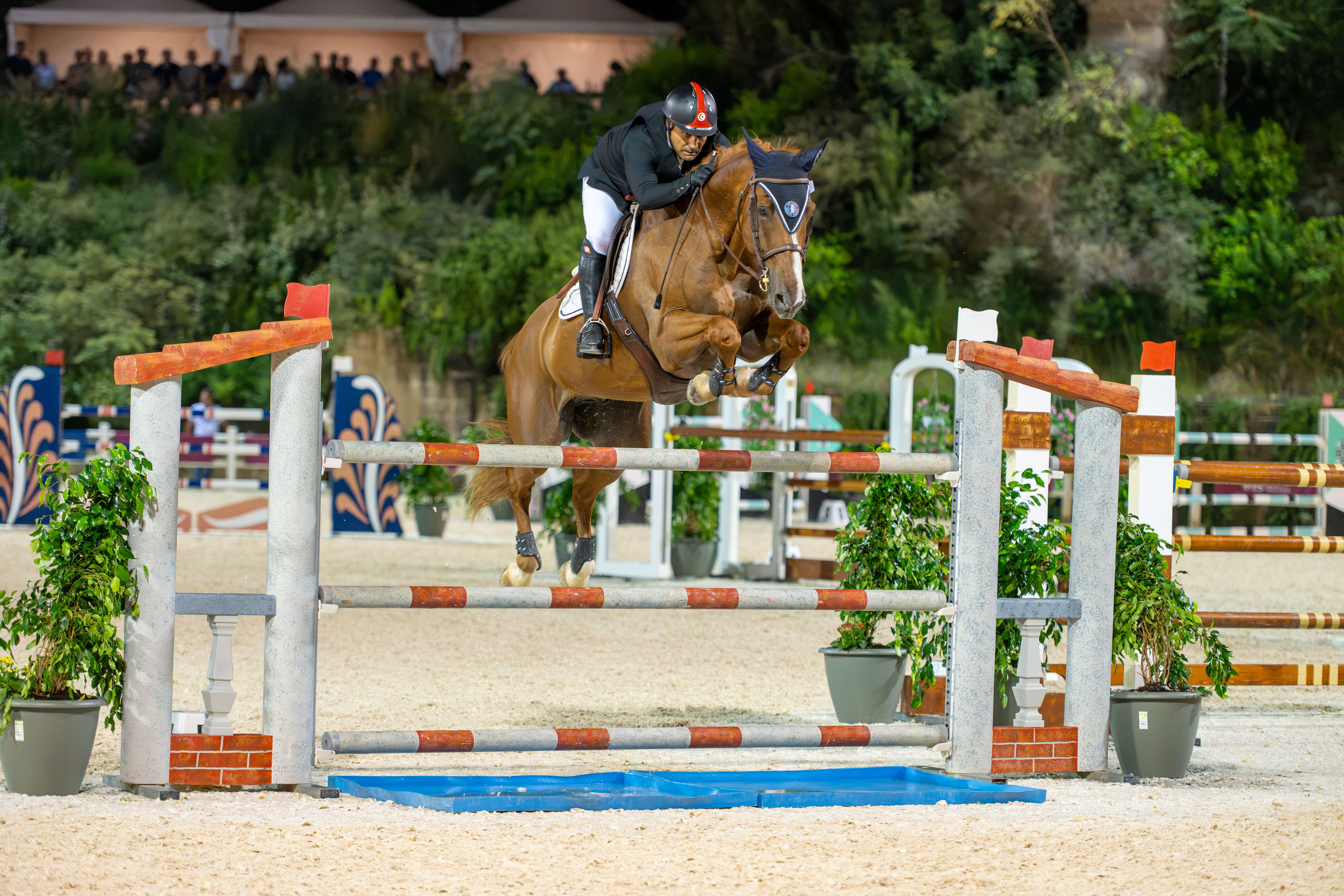
The 20th edition of the Mediterranean Equestrian Games came to a close on 1 September at the Horse Club Terra Jonica – S. Giorgio Jonico in Taranto.
The Tunisian squad selected by Coach Zied AOUINA to take part in these Mediterranean Games is as follows, in alphabetical order:
- Charles BEN MIMOUN and SO SEE YOU JAMES Z
- Ghazi ELLOUZE and BRASILIA DE L'ABBAYE
- Mohamed GUIZANI and EDELBERT DU HOUSSOIT
- Omar TRABELSI and BLACK STAR
Following the team events, which took place on 30 August 2026 from 5.30 pm, Tunisia finished 8th out of 10 competing teams and, at the end of the two rounds, had accumulated 37 penalty points across its three riders:
- Ghazi ELLOUZE et BRASILIA DE L'ABBAYE with 8 pts of penalties
- Omar TRABELSI avec BLACK STAR with 9 pts de pénalités.
- Mohamed GUIZANI avec EDELBERT DU HOUSSOIT with 20 pts of penalties.
The courses consisted of a course with 13 obstacles and 16 jumps at a height of 1.40 meters.
For the individual final on 1 September, the events were contested by 32 competitors representing 14 nations. The events comprised two rounds at 1.40m: the first round consisted of twelve obstacles and fifteen jumps, including a water jump, whilst the second round was shortened to nine obstacles and eleven jumps.
For the final standings, the results of these two rounds were combined with those of the two team rounds held on Sunday 30 August.
The final individual standings were as follows:
Rank Name Horse Result
10 Ghazi ELLOUZE BRASILIA DE L'ABBAYE 8
25 Mohamed GUIZANI EDELBERT DU HOUSSOIT 40
EL Omar TRABELSI BLACK STAR
You can view the photos from this event by clicking HERE.
To download all the results, click on Team Ranking and Individual Ranking.
- Details
- Federal News
With the arrival of autumn rains combined with temperatures exceeding 20°C, the proliferation of insects, particularly the Culex mosquito, increases, with an increase in its breeding sites.
This mosquito is the vector for transmission of the West Nile virus between birds (migratory and sedentary), which act as reservoirs for the virus.
Also, the mosquito harboring the virus transmits it by bite to humans, causing flu-like symptoms, and to other domestic mammals, including horses, causing fever and nervous disorders.
These accidental hosts are epidemiological dead ends for the disease and therefore do not contribute to the spread of the virus, and there is no transmission of the virus between humans or horses.
In Tunisia, West Nile fever has been diagnosed in humans and horses since 2003. In recent years, the disease has been confirmed by laboratories in humans and horses (the latest in 2024), with cases of mortality or sequelae of nervous system damage.
West Nile fever is a notifiable disease that does not place the horse in isolation or quarantine the stable.
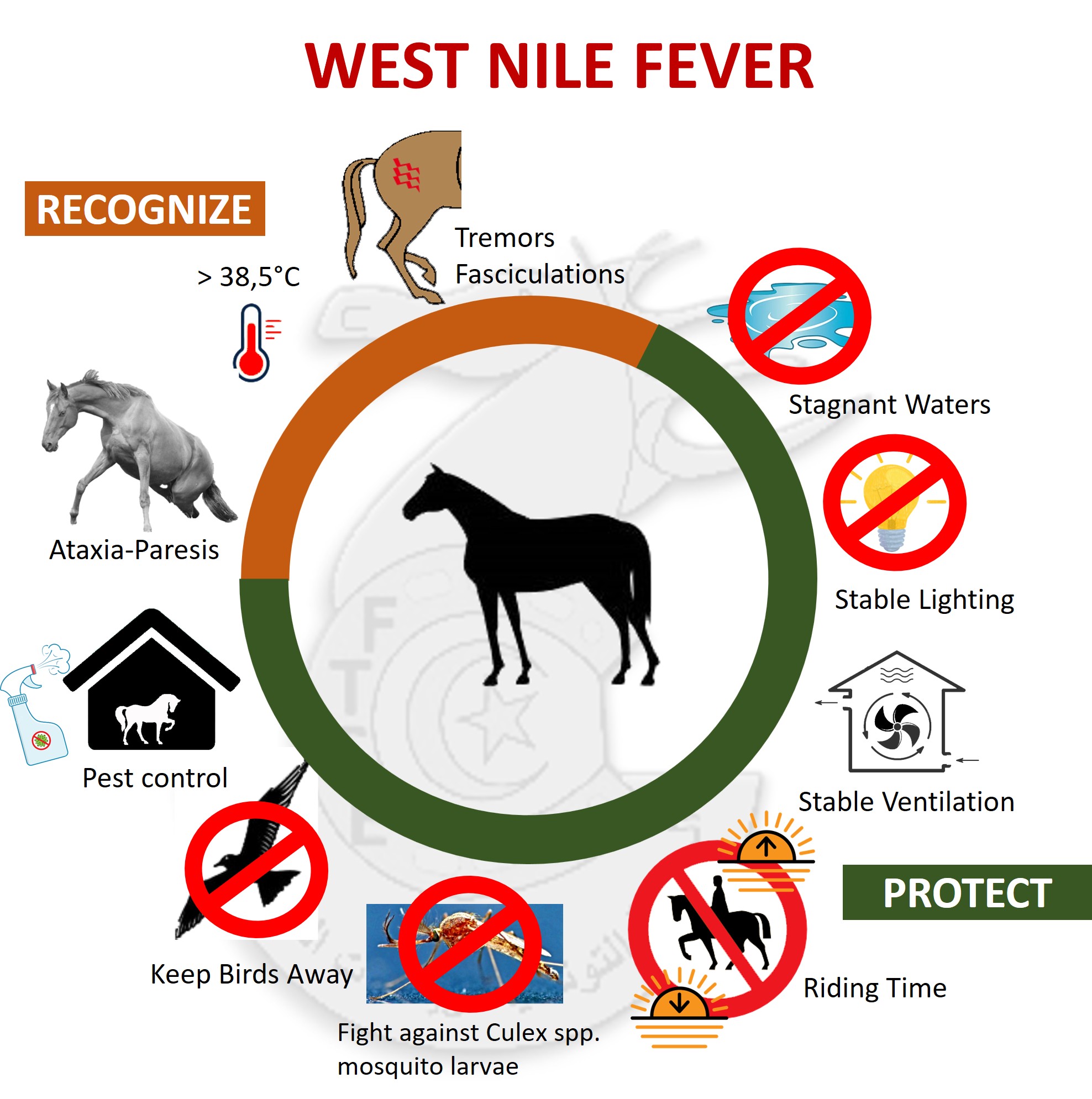
How to recognize the disease
"My horse is behaving strangely" including:
- Ataxia (impaired coordination of movements) and locomotor difficulties that can lead to paralysis,
- Depression or, conversely, hyperexcitability, as in rabies, but without hypersalivation. This is why West Nile fever is often diagnosed in the laboratory after rabies is suspected,
- Muscle tremors,
- Hyperthermia (temperature > 38.5°C) and a decline in general condition.
Cases recover within 20 to 30 days, with sequelae that can persist for up to 6 months after infection.
How to combat this disease
The vaccine against this disease has proven effective in countries where it is marketed, which is not the case in Tunisia.
Other preventive measures are employed and consist of minimizing horses' contact with mosquitoes during high-risk periods (i.e., summer and autumn):
- Bring horses inside closed buildings before the end of the day and take them outside after dawn (i.e., outside periods of peak mosquito activity).
- Place mosquito nets at the entrances to stables.
- Natural or dynamic ventilation of stables,
- Avoid lighting the boxes and the stable,
- Install insect traps in stables and/or the surrounding environment and use larvicidal insecticides,
- Eliminate migratory bird nests, place chicken coops and ornamental birds away from stables,
- Use repellents on horses, while changing the molecules to prevent insect resistance.
- Limit stagnant water as much as possible (tarpaulins, ruts, trampling areas, flowerpots, tires, etc.).
- Clean water troughs regularly.
- Install a full, fine-mesh mosquito net cover impregnated with a repellent product.
- Details
- Federal News
In order to protect the health of horses and combat the spread of contagious equine diseases among horses participating in equestrian sports events organised by the Tunisian Equestrian Sports Federation or in competitions organised under its supervision, and following the availability of the vaccine against equine rhinopneumonitis in Tunisia (combined vaccine with equine influenza), it will be mandatory, with effect from 1 June 2026, for all horses participating in national and international sporting events to be vaccinated in accordance with the vaccination schedule against infectious diseases in horses (equine influenza, equine rhinopneumonitis and rabies).
Furthermore, the Tunisian Equestrian Sports Federation invites the presidents of the equestrian sports associations affiliated to it to attach the utmost importance to this matter and to raise awareness amongst their members and supporters regarding compliance with preventive measures relating to biosecurity procedures, in order to ensure the continuity of sporting activities throughout the sporting season.
Sanctions will also be applied for any violations observed. For further details, click HERE.
- Details
- Federal News
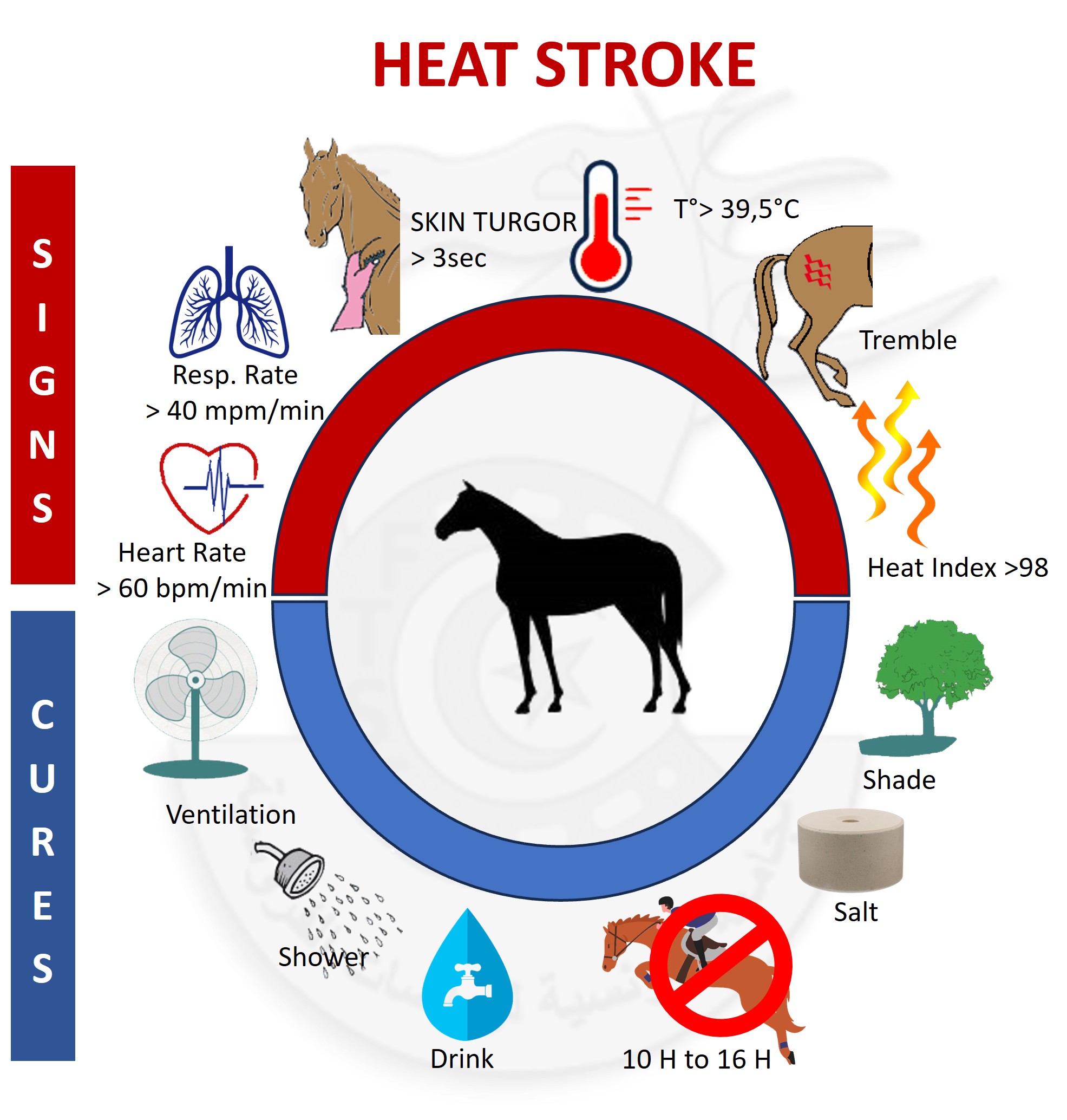
With rising summer temperatures accompanied by high humidity during the day and night where the heat index (the sum of recorded temperature and humidity) exceeds 98, you should closely monitor your horse for the following warning signs of heat stress:
- rectal temperature above 39.5°C;
- rapid respiratory rate over 40 bpm, elevated heart rate over 60 bpm at rest;
- profuse or absent sweating;
- sudden fatigue, muscle tremors, dry gums with a filling time exceeding 3 seconds;
- dehydration with a skin fold that lasts more than 3 seconds.
- dark urine, prostration, loss of appetite.
Prevention is better than cure:
- Provide fresh water day and night, to which 30 to 60 g are added per day, and electrolytes by soaking hay or pellets.
- Showers and ventilation with misters are recommended, allowing for a rapid drop in body temperature. - Provide shaded and well-ventilated shelters, whether in a paddock or a stable.
- Avoid sporting activities between 10 a.m. and 4 p.m.
- Transport: a risk that increases the risk of heat stroke, and therefore, ensure maximum ventilation with stops every 1.5 hours, misting with water and electrolytes at each stop, and avoid journeys between 11 a.m. and 6 p.m.
- Details
- Federal News
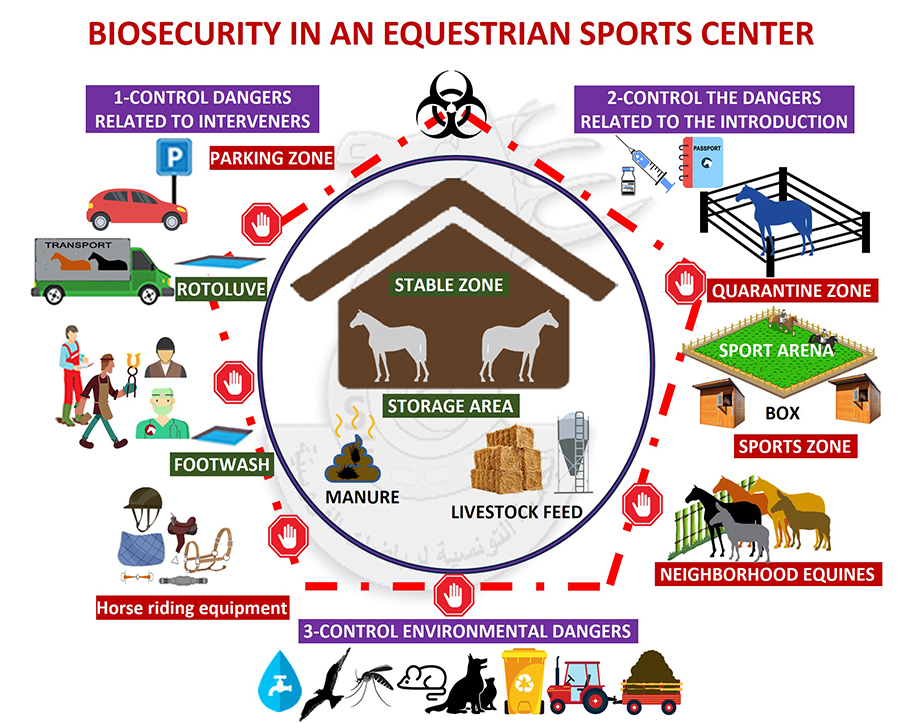
1-CONTROL HAZARDS RELATED TO INTERVENERS
- Install a fence around the establishment to control access.
- Provide parking outside or inside the establishment, away from the stables.
- Provide a fenced area for storing roughage and concentrated feed.
- Provide a fenced area for temporary manure storage.
- Provide a wheel washing basin at the entrance to the establishment for vehicles (cars and transport trucks, bicycle).
- Clean and disinfect horse transport vehicles before use.
- Provide a footbath at the entrance to the stable for authorized personnel (farrier, rider, veterinarian, stable staff).
- Do not use the same tack equipment for all horses in the stable and, if necessary, disinfect the equipment before each use.
- Provide hand-washing points.
2-CONTROL HAZARDS RELATED TO INTRODUCTION
- Set up a quarantine area at least 50 meters from the stable to isolate newly arrived horses for 21 days after purchase to ensure they are disease-free.
- Upon returning from an event (sporting or otherwise), monitor the competition horse, taking its temperature twice a day for 3 days, and separate it from horses that have not left the facility.
- Pets (cats and dogs) not belonging in the establishment can be disease vectors.
3-CONTROL ENVIRONMENTAL HAZARDS
- Avoid all contact with horses outside the facility during rides, equestrian events, or in pastures.
- Have a pest control plan.
- Have a plan for the removal of manure and all types of waste from the establishment.
4-CONTROL HAZARDS INSIDE THE STABLE
- Set up a feed storage area near the stables.
- Set up a temporary manure storage area more than 100 meters from the stables.
- Install a permanent fence to protect horses in the stable from contact with neighboring equines (horses, donkeys, mules).
- Provide each horse with its own water trough and feed trough, which must be cleaned daily.
- Vaccinate and deworm horses.
- Provide each horse with an accompanying document or passport.
- Provide each horse with an individual Health Record.
- Maintain a breeding register to track horse movements.
- Identify all horses with a microchip.
- Provide each horse with its own tack.
- Have a firefighting plan.
- Have a stable cleaning and disinfection plan.
5- MANAGING THE EMERGENCE OF DISEASE IN A STABLE
- Isolate the sick horse from other healthy horses, and a veterinarian must be invited to examine it.
- Limit staff movement and divide the stable into two zones: the infected zone and the healthy zone.
- Respect the principle of "forward movement" from the healthy zone to the infected zone.
- Start by grooming and cleaning healthy horses before sick horses.
- Turn healthy horses out into the paddock before sick horses.
- Wash your hands as frequently as possible before moving from one horse to another.
- Monitor the health of all healthy horses in the stable daily.
- Establish a twice-daily temperature check for all horses in the stable.
- Implement the cleaning and disinfection plan for the stable, tack equipment, and maintenance utensils.
- Immediately report to the veterinary services of the regional agricultural delegations any contagious animal disease subject to regulations and general control measures.
More Article ...
Page 1 of 3